
Choosing a top dressing spreader for your lawn
A top dresser distributes material over a lawn or prepared area. It can help with applying a dressing for minor surface levelling or soil improvement, depending on the material selected. Spreading is one part of the job: you may still need to work the material into the surface with a suitable rake or lawn levelling tool.
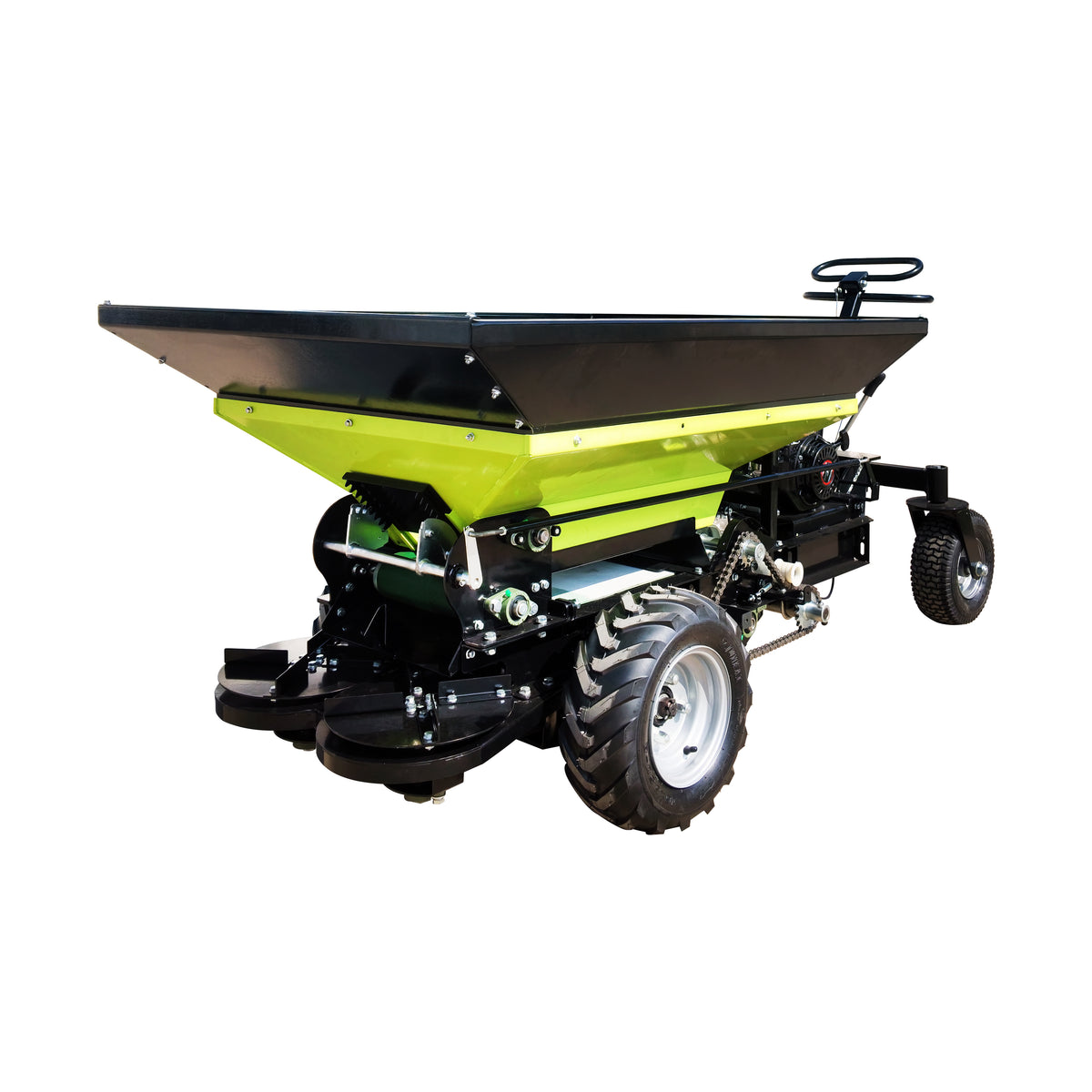
BM11170: a self-propelled petrol top dresser
The Forestwest BM11170 top dressing spreader is the model currently offered in this collection. Its own engine powers travel and spreading, making it an option for larger lawns and landscaping jobs where you want to work without a separate towing vehicle.
- 7HP petrol engine and electric start: standalone power for regular spreading work.
- Hopper rated up to 400kg, with approximately 0.33m³ volume: respect both limits; the weight of a full hopper depends on material density and moisture.
- Specified spreading width of approximately 3–6m: actual coverage varies with the material, settings and operating conditions.
- Adjustable output: test the application on a small area before treating the whole lawn.
- Three forward gears, neutral and reverse: with differential steering to assist manoeuvring.
Check overall operating dimensions, loaded weight, site access and transport arrangements before ordering. Hopper capacity alone does not tell you whether a machine will suit a narrow gate or a small enclosed lawn.
Sand, compost and soil: materials tested by Forestwest
Forestwest has tested the BM11170 with dry sand, slightly damp sand, compost, potting mix and soil. This provides a starting point when considering it as a sand spreader or compost spreader, but different batches can behave differently. Moisture, particle size, clumping and fibrous content all matter.
Slightly damp sand should not be treated as equivalent to saturated sand or sludge. Check material preparation and loading requirements in the operating instructions, and ask Forestwest about your particular material if its condition differs from those described. Being able to spread a material also does not mean it is the right dressing for every lawn: choose a mix suited to your turf and soil.
Plan the lawn renovation around the job
- Excess thatch: where removal is appropriate for your grass, the BM11167 lawn dethatcher and power rake performs a different task from spreading a dressing.
- Soil aeration: the BM11132 tow-behind spike aerator makes holes in the soil and needs a suitable towing vehicle. It is not a hollow-tine corer and does not remove soil plugs.
- Complete turf replacement: a BM11166 turf cutter cuts beneath the old turf so it can be lifted. Top dressing alone will not remove an unwanted lawn.
Only include the operations your lawn actually needs. For more equipment-selection advice, explore our lawn dethatchers and power rakes and turf cutters.
Top dressing spreader FAQs
Is a top dresser the same as a top dressing spreader?
In lawn-care equipment listings, top dresser, topdresser and top dressing spreader commonly describe machines used to distribute dressing material. Designs differ, so compare the drive system, compatible materials and application controls rather than choosing by the name alone.
Can the BM11170 spread damp sand?
Forestwest has tested it with dry and slightly damp sand. This does not establish suitability for every moisture level or sand grade. If your sand is very wet or clumped, confirm its suitability before loading the machine.
Can it spread compost, potting mix and soil?
Yes. These are among the materials Forestwest has tested with the BM11170. Composition and texture vary between suppliers, so check your material and carry out a small trial to assess feeding and distribution before committing to the whole job.
Do I need a tractor or ride-on mower?
No. The BM11170 has its own petrol-powered travel system. It is a self-propelled top dresser, rather than a tow-behind attachment. Transporting it between sites is a separate consideration.
How much top dressing material do I need?
For planning, volume in cubic metres equals area in square metres multiplied by layer thickness in millimetres, divided by 1,000. For example, 100m² at an average 3mm thickness requires approximately 0.3m³, or 300 litres, before allowing for wastage. This is a quantity example, not a recommended depth for every lawn. Material weight depends on bulk density, and the required volume may need several loads.
Will the machine level the lawn automatically?
No. It distributes material; it does not measure or correct the lawn's levels automatically. Assess low spots separately and work the dressing into the surface as appropriate. Keep grass leaf tips exposed and avoid burying the lawn under a heavy layer.
When should I top dress a lawn in Australia?
Plan lawn renovation for a suitable period of active growth, with time for recovery. The timing depends on your grass variety and local climate. Follow local turf advice for the material and depth, rather than treating one month or one application rate as suitable across Australia.
Can I use a normal fertiliser spreader for top dressing?
Do not assume a spreader designed for small fertiliser granules can also feed sand, compost or soil. Check the manufacturer's supported materials and feeding system. The BM11170's tested materials are listed above to help you assess the actual job.
For delivery and collection arrangements, see our shipping information and Click & Collect options.