
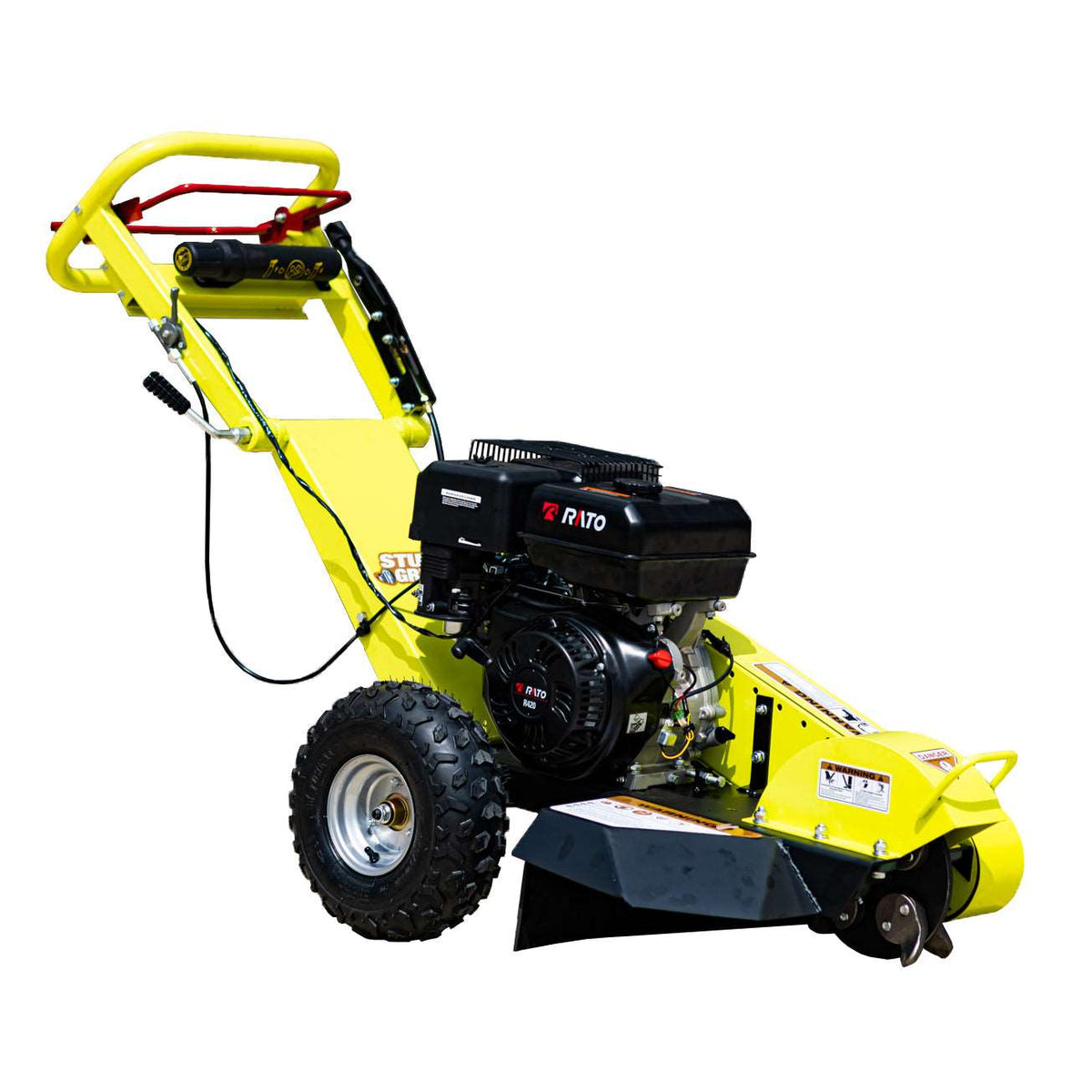
A stump grinder breaks down a tree stump using a rotating cutting wheel fitted with teeth. Instead of pulling the stump from the ground, it progressively cuts away the wood, leaving a mixture of woodchips and soil.
This can remove a stump that obstructs mowing, creates a trip hazard or occupies space needed for landscaping. However, grinding a stump and excavating its root system produce different results.
Understanding that difference helps you choose the right method before buying equipment or arranging a contractor.
How does stump grinding work?
The cutter removes wood in repeated, controlled passes. As material is removed, the operator works progressively through the stump and, where appropriate, below the surrounding ground level.
The aim is not to cut through the entire stump in one movement. Progress depends on the machine, tooth condition, timber and operating technique.

A stump grinder is also different from a wood chipper. A chipper processes suitable branches fed into it; a stump grinder works on the stump remaining in the ground.
What remains after stump grinding?
Grinding usually leaves:
- Woodchips mixed with soil.
- A depression where the stump material was removed.
- Roots extending beyond the area that was ground.
- Potentially some stump material below the chosen grinding depth.
It does not automatically remove every root or leave a finished surface ready for paving or planting.
The intended use of the area should determine how the work is planned and how the resulting space is restored.
Stump grinding vs excavation
| Question | Stump grinding | Excavation |
|---|---|---|
| How is the stump removed? | Wood is progressively cut into smaller pieces | The stump and accessible root material are dug out |
| What happens to surrounding roots? | Many remain outside the grinding area | More root material can be removed, depending on the excavation |
| What material needs managing? | Woodchips and disturbed soil | A larger stump or root mass and excavated soil |
| What should guide the choice? | Required depth, access and future landscaping | The need to remove buried material and the extent of permitted disturbance |
Grinding can be appropriate where removing the visible obstruction is the main objective. Excavation may be needed where remaining woody material would interfere with the planned work.
For a footing, retaining wall or other structural project, ask the responsible contractor or engineer what must be removed. Grinding below the surface is not proof that the ground is suitable for construction.
Does stump grinding stop a tree from growing back?
Not always. Some species can produce shoots from surviving roots or remaining tissue.
Grinding removes material in the worked area, but it should not be described as a guaranteed treatment for all regrowth. If the tree is known to sucker or you are dealing with an invasive species, seek advice from a qualified arborist about the complete removal plan.
How deep should a stump be ground?
The appropriate depth depends on what will happen next. Restoring lawn, reshaping a garden bed and preparing for construction can require different approaches.
The machine’s maximum cutting depth is an equipment limit, not a universal recommendation for every job.
For example, the Forestwest BM11075 15HP stump grinder lists a cutting depth of up to 300mm below ground. That figure does not describe the stump’s maximum diameter or establish how deeply your particular site should be ground.

What should you do with the woodchips?
Once the machine is stopped and the area is safe, assess the mixture of chips and soil.
Clean, suitable woodchips may be useful elsewhere as surface mulch. For restoring a level lawn or planting area, remove excess woody material and use appropriate soil rather than filling the space entirely with chips. Woody material decomposes and can contribute to later settlement.
Recheck the area over time and top up or regrade it if necessary.
Choosing equipment for the work
Match the machine to both the stump and the route used to reach it. Consider access, movement between stumps, transport and the amount of repeated work.
The BM11169 27HP self-propelled stump grinder provides powered travel for moving and positioning the machine. This is a handling feature, separate from the basic grinding process.
You can compare both machines in the Forestwest stump grinder collection. Begin with the result your site needs, then choose the equipment or professional service suited to achieving it.