
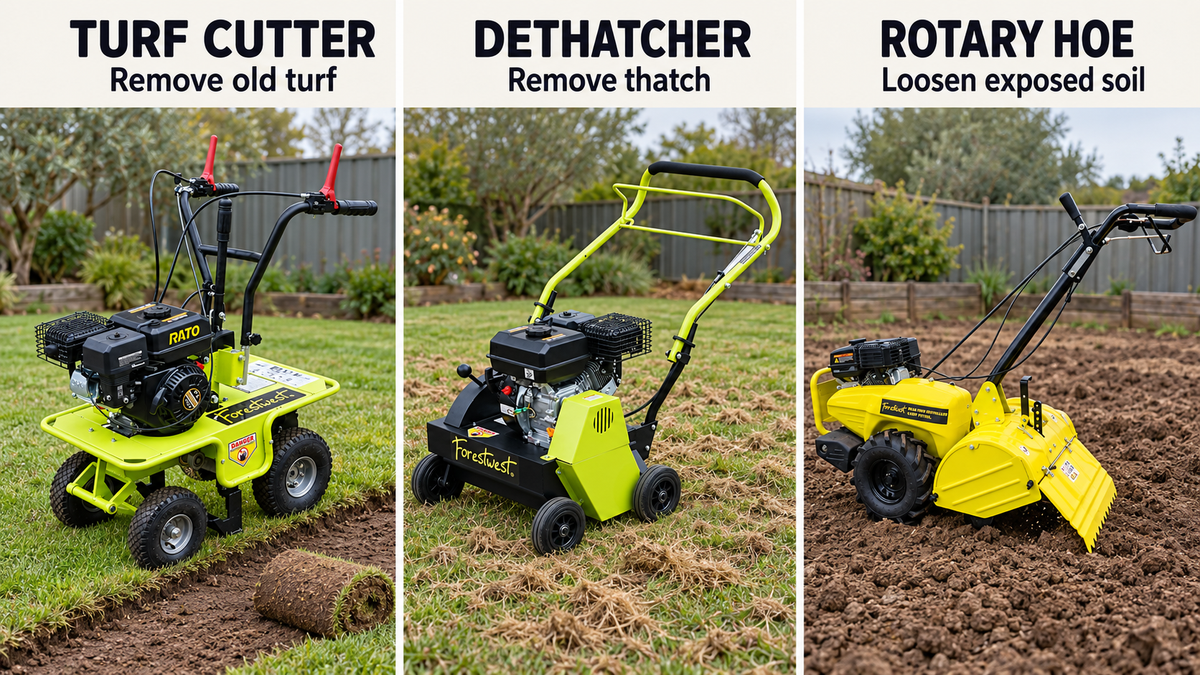
If you are renovating a lawn, three machines often appear in the same conversation: a turf cutter, a lawn dethatcher and a rotary hoe.
They can all be used during lawn renovation, but they perform completely different jobs. Using the wrong one can create unnecessary work and, in some cases, make the site harder to prepare.
The simplest way to understand the difference is:
- Turf cutter: removes the existing lawn as a layer.
- Dethatcher or power rake: removes built-up thatch while generally keeping the lawn.
- Rotary hoe or tiller: cultivates and loosens the soil.
Here is how to decide which one you actually need.
What Does a Turf Cutter Do?
A turf cutter, also called a sod cutter, uses a horizontal cutting blade underneath the turf to separate the grass and root layer from the soil below.
The cut turf can then be lifted, rolled or removed in sections.
A turf cutter is primarily used when the existing lawn is being completely removed.
Typical turf cutter jobs include:
- removing an old lawn before laying new turf;
- changing from one grass variety to another;
- removing lawn before creating garden beds;
- preparing an area for paving, paths or landscaping;
- lifting healthy turf for relocation;
- lowering an existing lawn level before reconstruction.
A turf cutter is not intended to simply improve an existing lawn. Once you use one across the whole area, you are generally committing to removing the turf layer.
For larger jobs, self-propelled machines reduce the amount of manual pushing required. The Forestwest BM11166 Self-Propelled Turf Cutter, for example, has a 305mm working width and adjustable cutting depth up to 35mm. Regardless of the machine used, the aim should be to cut beneath the turf root layer without unnecessarily removing large amounts of topsoil.
What Does a Lawn Dethatcher Do?
A lawn dethatcher or power rake works from the top of an established lawn.
Its job is to loosen and remove thatch — the layer of dead and partly decomposed stems, roots and organic material that can accumulate between the green grass and the soil surface.
Unlike a turf cutter, a dethatcher is generally used when you want to keep the existing lawn.
A dethatcher may be appropriate when:
- the lawn feels spongy underfoot;
- there is a visible build-up of thatch;
- water is having difficulty reaching the soil surface;
- the lawn is being renovated but does not need complete replacement;
- you want to open the turf canopy before other renovation work.
A dethatcher should not be confused with a turf cutter. It does not normally remove the lawn as an intact layer.
For larger established lawns, equipment such as the Forestwest BM11167 Lawn Dethatcher & Power Rake uses a rotating flail reel to work through accumulated thatch while leaving the underlying lawn in place for renovation.
What Does a Rotary Hoe Do?
A rotary hoe, rotary tiller or tiller cultivator uses rotating tines to break up, loosen and mix soil.
Its job is below the turf layer.
A rotary hoe can be useful for:
- loosening compacted soil;
- preparing garden beds;
- mixing suitable organic matter or soil amendments;
- preparing exposed ground after old turf has been removed;
- cultivating previously worked soil;
- preparing planting areas before levelling.
For lawn replacement, rotary hoeing normally comes after the old turf has been removed, not instead of turf removal.
If you rotary hoe directly through an established lawn, you can chop grass roots, runners and turf into the soil. That may be acceptable in some land-cultivation situations, but it is usually not the cleanest approach when preparing a residential area for new turf.
For walk-behind soil preparation, a machine such as the Forestwest BM11123 Dual Rotating Rear Tine Tiller is intended for cultivation after the surface vegetation has been dealt with.
Turf Cutter vs Dethatcher vs Rotary Hoe: Quick Comparison
| Machine | Main Job | Existing Lawn | Works Mainly On | Typical Use |
|---|---|---|---|---|
| Turf Cutter / Sod Cutter | Remove turf layer | Removed | Grass roots and upper soil layer | Complete lawn replacement |
| Dethatcher / Power Rake | Remove thatch | Generally retained | Lawn surface and thatch layer | Existing lawn renovation |
| Rotary Hoe / Tiller | Loosen and cultivate soil | Usually removed first for lawn replacement | Soil | Soil preparation |
Which Machine Do I Need If I Am Replacing My Entire Lawn?
If the existing lawn is being completely replaced, the usual sequence is:
1. Remove the existing turf → 2. Prepare the exposed soil → 3. Correct drainage and levels → 4. Lay new turf.
For a mechanical renovation, that can mean:
Turf Cutter → Rotary Hoe if required → Levelling → New Turf
The rotary hoe is optional. If the soil underneath is already suitable, well structured and at the correct level, unnecessary cultivation can create extra work.
Which Machine Do I Need If My Lawn Is Still Worth Saving?
If you want to keep the existing grass, start by diagnosing the actual problem.
If excessive thatch is the main issue, a dethatcher may be appropriate.
If compaction is the problem, aeration may be more useful than dethatching.
If the lawn is thin because of shade, poor drainage, incorrect irrigation or unsuitable grass variety, running a machine over it will not necessarily solve the underlying cause.
The key point is that lawn renovation should start with diagnosis, not equipment selection.
When Should I Use a Turf Cutter and Rotary Hoe Together?
They are commonly used together during a complete lawn rebuild, but they perform two separate stages.
Stage 1 – Turf cutter
Remove the existing grass and root layer cleanly.
Stage 2 – Soil inspection
Check compaction, drainage, soil depth, pH, weeds and levels.
Stage 3 – Rotary hoe, if required
Cultivate soil that genuinely needs loosening or blending.
This distinction matters because rotary hoeing soil that is already suitable can leave you with an unnecessarily loose surface that then needs additional levelling and consolidation.
Can I Use a Rotary Hoe Instead of a Turf Cutter?
Technically, a rotary hoe can break up turf and soil together, but that does not make it the best method for every lawn replacement.
If your goal is to produce a clean surface and physically remove the old grass, a turf cutter is usually more controlled because the existing turf is separated as a layer.
Rotary hoeing directly through an established lawn mixes vegetation into the soil and can spread grass runners and roots throughout the cultivated area.
For a vegetable plot, paddock or general cultivation project, that may not be a major concern. For a carefully prepared residential lawn base, clean removal first is often easier to manage.
Can I Use a Dethatcher Instead of a Turf Cutter?
No, not if the goal is complete lawn removal.
A dethatcher works through the upper thatch layer. It is not designed to cut underneath the full turf root zone and lift the lawn as sod.
If the grass variety itself needs to be removed, or you need to lower and rebuild the lawn profile, a turf cutter performs a fundamentally different task.
Do I Need a Dethatcher and an Aerator?
Possibly, but they solve different problems.
A dethatcher addresses material accumulating around the turf surface.
An aerator creates openings in the soil profile to improve movement of air and water into compacted ground.
For established lawns where soil compaction is the main issue, aeration may be more relevant. For larger properties using a suitable towing vehicle, you can also explore the Forestwest Lawn Aerator range.
A Practical Decision Guide
Choose a turf cutter if:
- you are removing the whole lawn;
- you want to lay a different turf variety;
- you need to remove turf before landscaping;
- you want to lift intact sections of sod.
Choose a dethatcher if:
- you want to keep the lawn;
- thatch build-up is the main problem;
- you are undertaking surface-level lawn renovation.
Choose a rotary hoe if:
- you need to loosen exposed soil;
- the ground is compacted;
- you need to mix appropriate soil amendments;
- you are preparing soil after turf removal.
Example 1: Replacing a Patchy Old Backyard Lawn
The existing turf is full of unwanted grass and the owner wants a completely different variety.
A logical process would be:
- deal with the existing vegetation;
- remove the turf layer;
- inspect drainage and soil;
- cultivate only if the soil needs it;
- correct levels;
- install the new turf.
In this situation, a turf cutter is much more relevant than a dethatcher.
Example 2: Healthy Lawn With Heavy Thatch
The grass variety is suitable and there is no reason to replace the lawn, but the surface has become thick and spongy.
This is much more likely to be a dethatching job. Removing the entire lawn would be excessive.
Example 3: Turf Has Already Been Removed but the Soil Is Hard
The grass is gone, but the exposed ground is compacted and difficult to level.
This is where a rotary hoe or tiller may become useful. Cultivate only to the depth required for the soil-preparation work, then establish the correct surface levels before laying turf.
Common Mistakes to Avoid
Buying a machine before diagnosing the lawn
A brown or thin lawn does not automatically need dethatching, aeration or replacement. Identify the cause first.
Using a rotary hoe to solve every soil problem
Poor drainage, inappropriate soil levels and unsuitable soil chemistry cannot always be corrected simply by cultivating deeper.
Removing an entire lawn because of thatch
If the underlying turf is healthy, dethatching may achieve the renovation you need with much less disruption.
Using maximum cutting depth automatically
Whether using a turf cutter or rotary hoe, the deepest possible setting is not necessarily the correct setting. Use the depth required for the actual job and ground conditions.
Final Thoughts
A turf cutter, dethatcher and rotary hoe are not competing versions of the same machine. They work at different stages and solve different lawn problems.
Remember the basic distinction:
Turf cutter = remove the lawn.
Dethatcher = renovate the lawn surface.
Rotary hoe = prepare the soil.
Once you understand which layer of the lawn you actually need to work on, choosing the right equipment becomes much easier — and you are far less likely to create unnecessary work during your renovation.