
Keeping an Australian acreage tidy can involve several different mowing jobs: open paddocks, grass between orchard rows, narrow gateways and awkward sections around sheds or fences. A flail mower needs to suit that whole route, including how you will move it, power it and control it.
This flail mower buying guide compares the five mower models currently listed in the Forestwest flail mower range. Use it to narrow your options by access, working width and operating format, then check the selected machine against your property and its operator's manual.
Which flail mower should you consider first?
- Compact areas with an operator walking behind: start with the 600mm BM11172 self-propelled flail mower.
- Wider areas with walk-behind control: compare the 900mm BM11162 self-propelled flail mower.
- Remote operation with tracked travel: consider the 900mm BM11163 remote control flail mower.
- A compatible compact tractor is already available: check the 1250mm BM11135 tractor PTO flail mower.
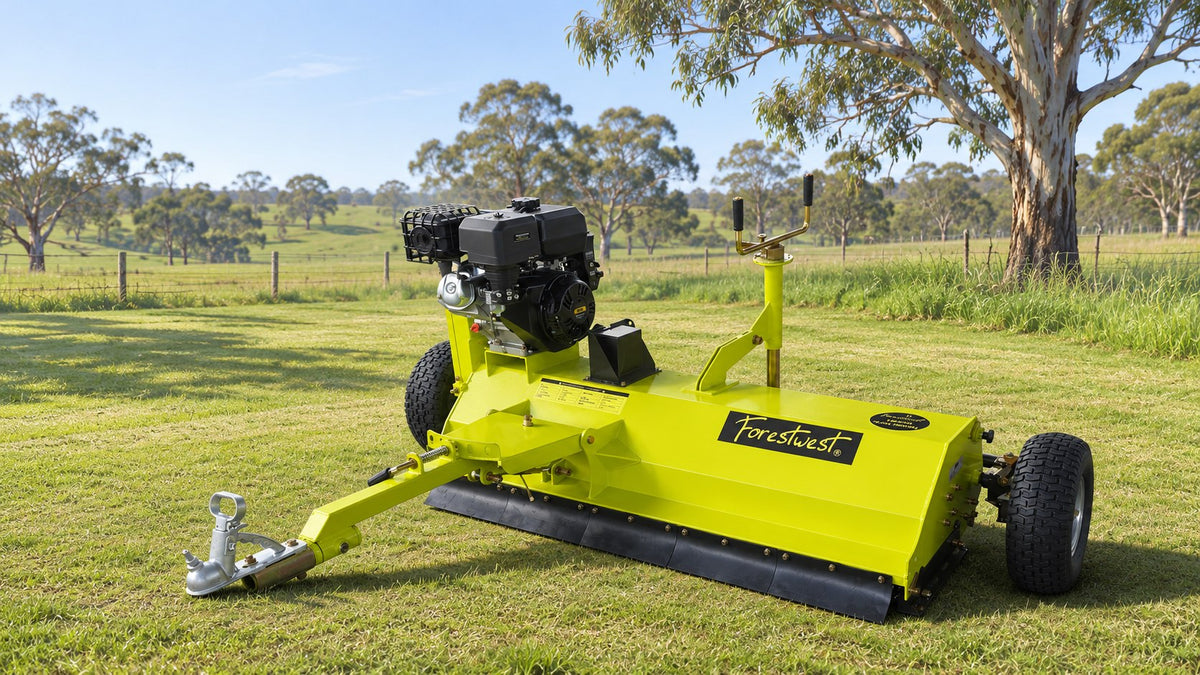
- A suitable towing vehicle is available: look at the 1450mm BM11141 tow-behind flail mower, which has its own petrol engine.
What does a flail mower do?
A flail mower uses a horizontal rotating rotor carrying swinging cutting blades. As the rotor turns, the flails cut vegetation and break up the cut material beneath the housing. This makes the format useful for managing grass, weeds and overgrown vegetation while leaving the cut material on the ground.
A conventional rotary slasher uses a different cutting arrangement with larger rotary blades. For a purchase decision, consider the vegetation you need to manage, the finish you want and the machine's specified capability. Cutting quality depends on blade condition, vegetation density, moisture and travel speed.
Choose a flail mower for its verified mowing application. Any woody-material capacity needs to be confirmed for the exact model before tackling scrub or saplings.
Map your mowing route before choosing a cutting width
Walk the property and identify the sections you will actually mow. Total acreage is only part of the decision: an open paddock and an orchard block of the same area create very different demands.
- Measure access: record gateway openings, orchard-row spacing, shed access and tight corners. Check the mower's overall width, including wheels or tracks, and allow clearance for manoeuvring.
- Assess the vegetation: note the grass height, density and frequency of regrowth. Separate routine maintenance areas from sections needing an initial clean-up.
- Inspect the ground: identify slopes, soft patches, ruts, rocks, wire, irrigation fittings and hidden obstacles. Some sections may need a different maintenance method.
- Plan handling: consider storage, loading, transport and how you will retrieve the mower if access becomes difficult.
A wider cutting path can reduce the number of passes on open ground. On a property with frequent turns and restricted access, a compact mower may fit the working route more effectively.
Forestwest flail mower comparison
The table below brings together the main published selection specifications. Product weight means the machine's listed net weight. Cutting width describes the cutting path; use overall dimensions when checking gates, storage or transport.
| Model | Operating format | Cutting width | Power source | Listed cutting height | Product weight |
|---|---|---|---|---|---|
| BM11172 | Self-propelled walk-behind | 600mm | 224cc petrol | 10–80mm | 92kg |
| BM11162 | Self-propelled walk-behind | 900mm | 420cc petrol | 5–40mm | 190kg |
| BM11163 | Remote control, tracked | 900mm | 420cc petrol | 0–120mm | 315kg |
| BM11135 | Tractor three-point linkage | 1250mm | 540rpm tractor PTO | 20–60mm | 145kg |
| BM11141 | Tow-behind | 1450mm | 15HP RATO petrol | 25–70mm | 252kg |
Specifications checked against Forestwest public product pages on 26 November 2026. A published height adjustment range is a selection specification; choose an operating setting appropriate to the ground, vegetation and manual. Check current product details and availability before ordering.
How the five Forestwest models fit different properties
BM11172: a compact self-propelled option for closer working areas
The BM11172 600mm petrol flail mower combines a 224cc engine with powered travel in a walk-behind format. Its transmission has two forward gears, neutral and reverse. The handle offers three height positions and left/right adjustment.
Shortlist it for orchard rows, smaller mowing sections and properties where larger equipment would be awkward to position. Measure the complete machine and your turning space when checking access.
BM11162: wider coverage with direct walk-behind control
The BM11162 900mm self-propelled flail mower has a 420cc petrol engine, electric and recoil starting, and two forward gears plus reverse. Its 900mm cutting path offers wider coverage for paddocks, acreage and larger orchard sections.
It is worth comparing when you want a self-contained mower and can comfortably guide a walk-behind machine across the intended work area. Include operator walking time and the machine's handling requirements in your assessment.
BM11163: remote control with a tracked platform
The BM11163 remote control flail mower combines a 900mm cutting width, 420cc petrol engine and tracked travel. Remote operation lets the operator control movement without walking directly behind the machine. Its 24V battery supplies the control system; the cutting power comes from the petrol engine.
Consider it where remote operation suits your property layout and mowing workload. Assess visibility, operator position, ground conditions and recovery access. Confirm permitted slope operation in the manual for your intended use.
BM11135: a PTO flail mower for a compatible compact tractor
The BM11135 1250mm tractor flail mower connects through a Category 1 three-point linkage and takes power from a 540rpm PTO. Its specification table lists a 20–30HP tractor requirement. The mower is supplied with a drive shaft and linkage pins.
It is a practical shortlist option for an owner with a suitable tractor and enough working room. Confirm tractor compatibility, lift capacity, shaft fitment and guarding before purchase; horsepower alone does not establish a suitable match.
BM11141: a wide tow-behind mower with independent engine power
The BM11141 1450mm tow-behind flail mower uses its own 15HP RATO petrol engine with electric start. It can be towed by a compatible ATV, quad bike, tractor or other suitable vehicle, without tractor PTO power. Its tow bar can pivot left and right.
Shortlist it for accessible paddocks and open acreage where the towing combination has sufficient room. Check the vehicle manufacturer's towing limits, hitch compatibility and terrain suitability. The mower is intended for off-road use.
Check these details before you buy
Cutting width, working time and the complete mowing route
Compare the width you can use throughout the property. A 900mm cutting path is 50% wider than a 600mm path, but actual work rate also depends on overlap, turns, vegetation density and suitable travel speed. For open areas, coverage matters; for divided blocks, access and repositioning may dominate the job.
Decide who will operate the mower and how often. A self-propelled machine assists travel while the operator walks and guides it. A remote control mower changes where the operator stands and how the work is controlled. Try to assess the whole session, including setup and moving between sections.
Tractor and towing compatibility
For a PTO mower, check the linkage category, specified PTO input speed, tractor power requirement and lift capacity together. Ask for help checking shaft length and articulation through the linkage's working movement. WorkSafe Victoria's PTO guarding guidance explains the importance of guarding the shaft and couplings and switching off the engine before working near the PTO.
For a tow-behind mower, assess the complete towing combination: vehicle, hitch, mower weight, ground conditions and available turning room. A mower with its own engine still places a towing load on the vehicle.
Slopes, visibility and ground conditions
Check slope requirements for the exact machine, travel direction and intended mowing task. A maximum climbing or walking-slope figure does not establish suitability for every mowing situation. Wet grass, loose soil, ruts and changes in slope need to be assessed on site.
With remote equipment, plan a position that keeps the mower and work area visible, and establish the exclusion area required by the manual. For all formats, inspect for debris and keep people and animals clear of the working area.
Transport, storage and ongoing parts
Include the mower's overall dimensions and product weight when planning trailer capacity, rated loading equipment, storage and servicing access. Check your loading arrangement before delivery, particularly for the heavier models.
Ask about replacement blades, belts and model-specific service parts. Forestwest lists replacement flail mower blades, including options for the BM11135 and BM11141. Confirm the exact blade type and fitment for your model when ordering replacements.
Plan mowing around Australian conditions
Build your mowing schedule around local growth and ground conditions. A damp orchard after rain, an exposed paddock and a drying summer verge can require different timing and preparation. Allow for inspection and cleaning as part of the job, especially where grass can accumulate around hot machine components.
Check current fire restrictions before operating. In Victoria, CFA highlights the ignition risk from mowing and slashing and advises against using this equipment on Total Fire Ban days. Read its guidance on using machinery for the relevant conditions.
In Western Australia, local governments issue Harvest and Vehicle Movement Bans. DFES explains how these bans work in its rural and farm fire guidance. Check with your local government before the job. Elsewhere in Australia, use your own state fire authority and local council's current advice.
Flail mower buying FAQs
What size flail mower do I need for an acreage?
Match width to the area you can reach and mow efficiently. Consider the usable gate openings, obstacles, vegetation and operating format alongside acreage. A property with small separate sections may favour a compact walk-behind mower; accessible open ground may suit a wider tractor or tow-behind setup.
Can I buy a flail mower without owning a tractor?
Yes. The BM11172 and BM11162 are self-contained petrol walk-behind machines, and the BM11163 is a petrol remote control machine. The BM11141 has its own engine and requires a compatible towing vehicle. The BM11135 requires a compatible PTO tractor.
Is a remote control flail mower a robotic mower?
The BM11163 is controlled by an operator using a remote. Plan for active supervision and a clear view of the work area. Choose it for the operating format and terrain requirements of the job.
Will a flail mower handle every kind of scrub?
Check the model's verified vegetation capability. Before tackling woody growth, ask for an explicit cutting-diameter rating and advice for that material. Cutting width and engine size do not specify the diameter of branches or saplings a mower can process.
What is the difference between a PTO and a tow-behind flail mower?
A PTO mower receives cutting power from the tractor. A tow-behind mower such as the BM11141 carries its own engine, while the towing vehicle moves it through the work area. Check attachment or hitch requirements as part of the purchase.
Find the right Forestwest flail mower for your property
Browse the complete Forestwest flail mower range, then contact the team with your mowing area, access measurements, vegetation photos and details of any tractor or towing vehicle. Those details help narrow the shortlist to a machine that fits your property and working routine.
Call 1300 281 198 or email sales@forestwest.com.au for help choosing a model.