
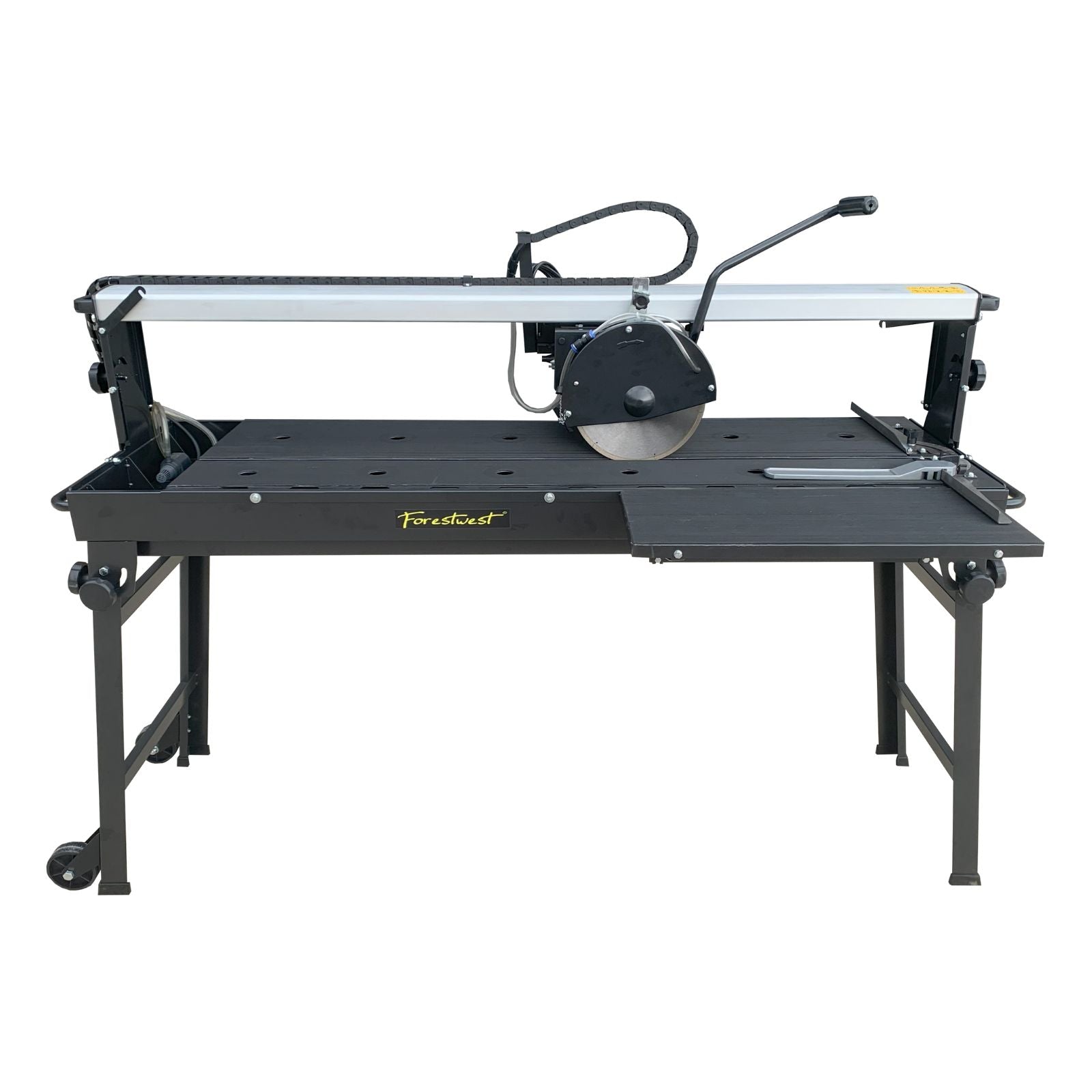
Do you know “How to Use Your Wet Tile Saw Properly”?
Whether you’re tackling a home renovation or working in the tiling industry, achieving clean, accurate cuts is essential. Both DIY users and professionals occasionally encounter issues such as chipped edges, snaking cuts, or a saw that doesn’t seem to perform as expected. Many of these problems can be avoided by choosing the right machine and setting it up correctly.
Choosing the Right Tile Saw for Your Project
We offer four wet tile saw models with varying cutting capacities, ranging from a compact 600mm unit to a professional 1250mm machine. Selecting the right saw depends on the scale of your project and the materials you plan to cut.
600mm 800W Wet Tile Saw – Entry Level
- Equipped with an 800W induction motor, water pump and 200mm diamond blade
- Integrated water tank beneath the cutting table for blade cooling
- Maximum straight cut: 600mm
- Cutting depth: 30mm (90°) / 25mm (45°)
- Adjustable blade angle from 90° to 45° for bevel cuts
Recommended for:
Small projects and cutting ceramic, homogeneous tiles, glass tiles, and mosaic.

720mm 1200W Wet Tile Saw – Intermediate/Professional
- 1200W induction motor with water pump and 230mm diamond blade
- Maximum straight cut: 720mm
- Cutting depth: 60mm (90°) / 48mm (45°)
- Adjustable blade angle from 90° to 45°
- Includes plunge‑cutting capability
Recommended for:
Full‑size renovation work and general tiling projects. Suitable for ceramic, mosaic, glass, porcelain, engineered stone, and quarry tiles (with the appropriate blade).

1000mm & 1250mm 1500W Wet Tile Saws – Professional Grade
- 1500W (2 HP) induction motor with water pump and 250mm diamond blade
- Large water tank for extended cooling
- Maximum straight cuts: 1000mm or 1250mm
- Cutting depth: 60mm (90°) / 48mm (45°)
- Adjustable blade angle from 90° to 45°
- Plunge‑cutting capability
Recommended for:
Large‑scale renovation and commercial tiling projects. Suitable for ceramic, mosaic, glass, porcelain, engineered stone, quarry, and natural stone (with the correct blade).

Setting Up Your Tile Saw
Each tile saw includes a user manual with assembly instructions. Always read and understand the manual before operating the machine.
Key Setup Steps
- Ensure both 90° and 45° positions is correctly set, you can fine tune with the adjustment screws.
- Check that the stop fence and tile guide are square to the blade.
- Perform several test cuts using scrap tiles to confirm accuracy.
- If cuts show imperfections, fine‑tune the adjustment screws until the blade aligns perfectly.
Water Pump Installation
- Install the water pump onto the bracket inside the water tank.
- Remove any debris from the tank to prevent pump damage.
- Ensure the pump is fully submerged before operating the saw.
Common Problems and Their Causes
Even with a quality machine, issues can occur. Most problems stem from setup, blade condition, or user technique—not the saw’s structure.
Snaking or Bent Cuts
- Uneven table surface causing tile movement
- Fence or tile guide not square
- Unsteady handling during cutting
Chipped Edges
- Tile movement during cutting
- Blunt or worn diamond blade
- Cutting delicate materials (e.g., porcelain, ceramic) without proper technique
Sparking During Cutting
- Blunt diamond blade
- Insufficient or dirty cooling water
- Excessive feed pressure on the blade
Lack of Cutting Power
- Blunt diamond blade
- Weak power supply (e.g., undersized or overly long extension cable)
- An impaired motor caused performance issues
Tips for Achieving Better Tile Cuts
A wet tile saw is straightforward to use, and small improvements in technique can make a big difference in cut quality.
- Keep the fence and tile guide square to the blade at all times.
- Ensure the cutting table is flat and free of debris.
- Clean the non‑slip mat regularly to prevent dust buildup in the grooves.
- Hold the tile firmly with steady, moderate pressure; avoid shifting during the cut.
- Practice your cutting motion with the machine switched off to find a natural, comfortable stance.
- For delicate materials (porcelain, engineered stone), score a shallow line (2–3 mm) first, then complete the cut slowly.
- Always use a sharp diamond blade—blade maintenance is cheaper than ruined tiles.
- Use a segmented diamond blade for quarry or natural stone.
- Keep the water tank clean and replace water when it becomes cloudy.
- For thick tiles, consider placing the pump in a separate bucket of running clean water to improve cooling and clean cut.
- Ensure your power supply is adequate, especially when using larger wet tile saws.