
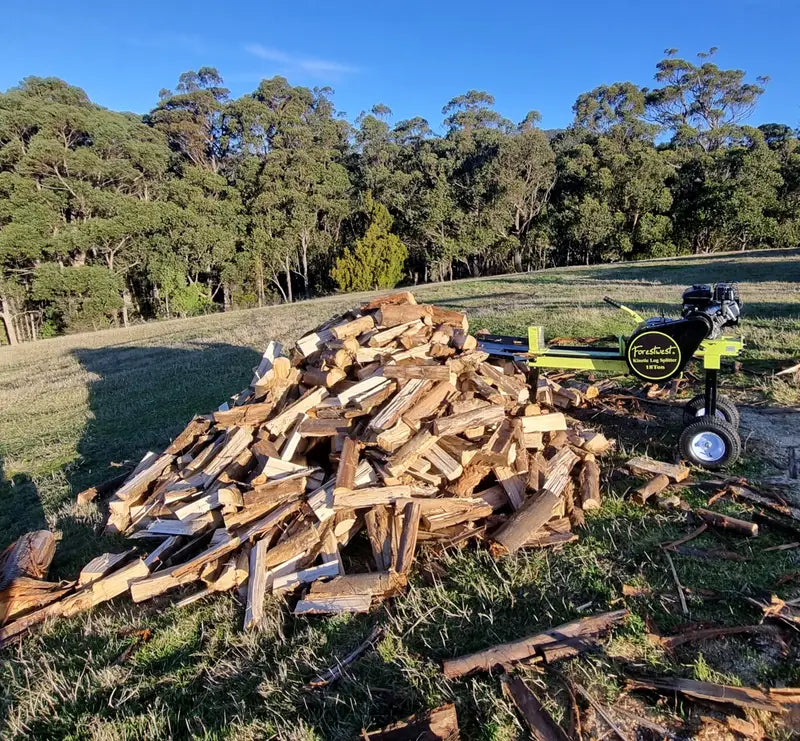
Regular care helps your kinetic log splitter work reliably throughout the firewood season. This guide covers power supply, cleaning, lubrication, petrol engine care and storage. Follow the operating and servicing instructions for your particular machine and engine.
If you are still choosing a machine, compare our electric and petrol log splitters by power supply, log size and working height.
Set up the right power supply
The BM11130 and BM11130S 12 Ton electric models and BM11097 18 Ton electric model require a suitable 10A supply. The BM11046 26 Ton electric model requires a suitable 15A supply. Check the machine's rating and manual before connecting it.
Can I use an extension lead?
Connect directly to a suitable mains power point whenever possible. If an extension lead is necessary, use a heavy-duty lead with the correct current rating and compatible plugs for your machine. We recommend a maximum length of 10 metres; shorter is preferable. Fully unwind the lead before use. A lead does not make an unsuitable power outlet suitable for the machine.
Can I run an electric log splitter from a generator?
Generator use is possible with a correctly matched supply, but Forestwest does not recommend it as the first choice. The generator must provide sufficient motor-starting capacity as well as continuous running output, with a suitable stable supply and compatible outlet. Do not select it solely by matching the motor's stated wattage. Contact Forestwest and the generator supplier to confirm compatibility before use.
Check the machine before splitting
- Use stable, level ground and keep the working area clear.
- Check guards, controls, leads and visible components for damage.
- Check log dimensions against your model's specifications. Species, moisture content, knots and grain affect splitting performance.
- Follow the manual's two-hand operating procedure and keep other people away from the splitting area.
Wear the protective equipment specified in the manual, including eye and hearing protection and suitable footwear. Operate petrol engines outdoors. Do not bypass safety controls.
Operate the controls correctly

Follow the two-hand operating procedure in your machine's manual. Guide the working handle back to its ready position after each split rather than allowing it to snap back by itself.
Clean and lubricate the kinetic mechanism
Switch off and isolate the power source, and allow all moving parts to stop before cleaning or maintenance. Remove wood chips and debris from the machine. Inspect and lubricate the rack and other specified points using the lubricant and intervals in your model's manual.

A kinetic splitter has no hydraulic splitting circuit to service, but it is not maintenance-free. Check the rack, pinion, belts and splitting wedge for wear. If performance changes or you hear unusual noise, stop using the machine and investigate before continuing.
Belt tension and wedge condition
With the machine switched off, isolated and all moving parts stopped, inspect the belt as described in your model's servicing instructions. Forestwest recommends approximately 10mm of belt deflection when gently pressed. Contact the team if you are unsure where or how to check this on your machine. Refit all guards before operation.
If the belt slips, the wedge is damaged or splitting performance changes, stop and arrange the appropriate inspection or servicing. Do not continue operating with a loose guard or damaged component.
Service the petrol engine
Petrol models need engine maintenance in addition to care of the splitting mechanism. Forestwest confirms that 10W-30 or 10W-40 engine oil can be used in its current petrol log splitter engines. Follow the engine manual for oil capacity, oil checks and service intervals, and contact Forestwest if you need help selecting the grade for your operating conditions.
Check fuel and the air filter as part of routine engine care. The absence of hydraulic oil does not mean the petrol engine requires no oil changes.
Prepare for storage
Clean the machine and store it in a dry, covered location. For petrol models, follow the engine manufacturer's fuel and carburettor storage procedure, particularly before a long period without use. Inspect the machine again before returning it to service.
Parts and support
Browse log splitter spare parts or request after-sales support. Include your model number and a description of the problem so the team can help identify the correct parts or procedure.