
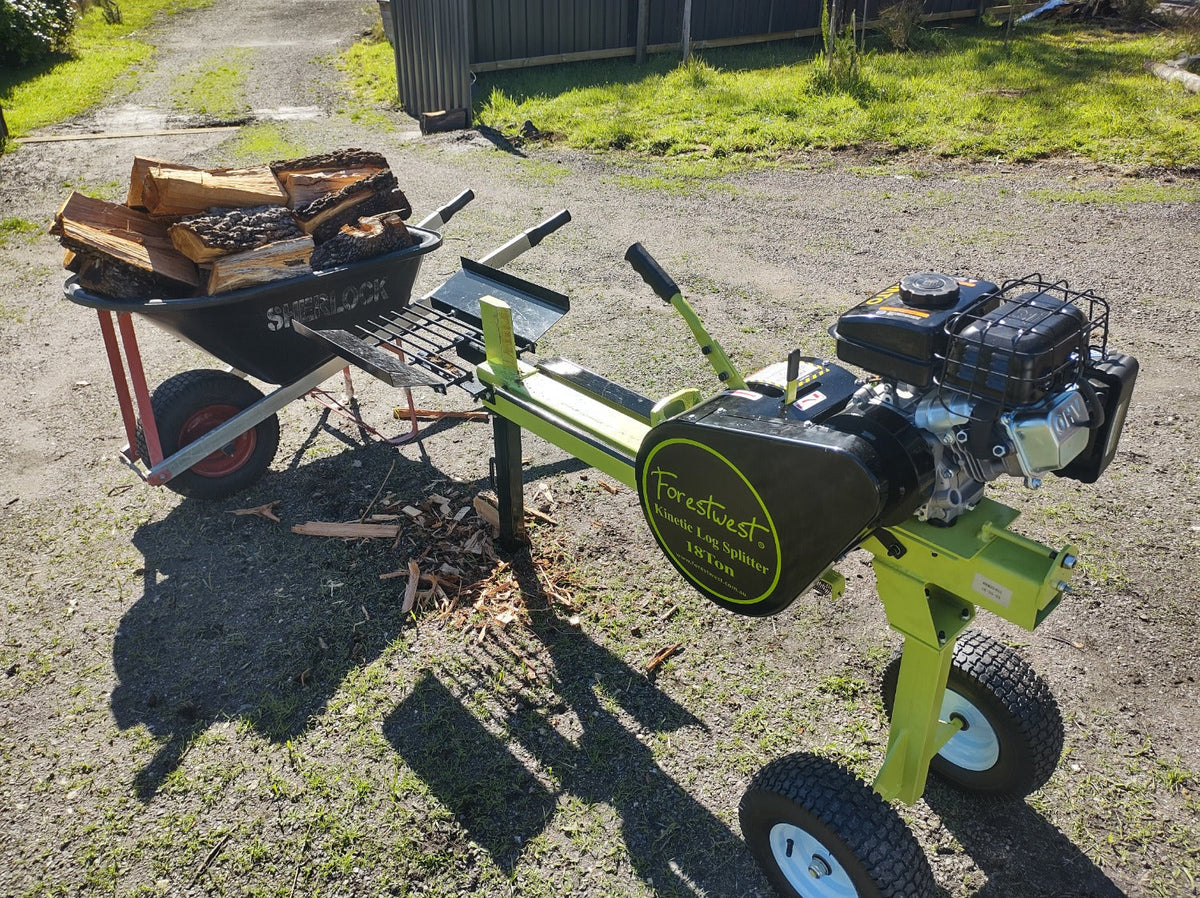
Choosing a log splitter starts with your firewood and where you will work. Measure your logs, check your power supply and consider the loading height before comparing Ton ratings. This guide explains the main decisions for Australian households and property owners.
For current models and availability, compare the Forestwest log splitter range.
Kinetic or hydraulic?
A hydraulic splitter uses a hydraulic cylinder to move the ram. A kinetic splitter stores energy in spinning flywheels and releases it through a rack-and-pinion mechanism. Forestwest's current range uses kinetic splitting, with fast split-and-return action and no hydraulic pump, hoses or hydraulic oil circuit to maintain.
Compare specific machines rather than assuming all kinetic models outperform all hydraulic models. Log condition and machine design matter, and both types require maintenance. Read our explanation of how kinetic log splitters work.

Electric or petrol?
Electric models suit work near an appropriate mains power supply and avoid petrol engine servicing. The 12 Ton and 18 Ton electric models require 10A; the 26 Ton electric model requires 15A.
Petrol models suit outdoor work away from mains power. The current petrol range includes 18 Ton, 34 Ton and 40 Ton machines. Allow for fuel and engine maintenance as well as log size and loading needs.

Compare current Forestwest models
| Model | Listed force | Power | Maximum log length |
|---|---|---|---|
| BM11130 | 12 Ton | 1800W electric, 10A | 400mm |
| BM11130S | 12 Ton | 1800W electric, 10A | 400mm |
| BM11097 | 18 Ton | 2200W electric, 10A | 400mm |
| BM11046 | 26 Ton | 3500W electric, 15A | 710mm |
| BM11097P | 18 Ton | 3HP petrol | 400mm |
| BM11038 | 34 Ton | 6.5HP petrol | 710mm |
| BM11039 | 40 Ton | 7HP petrol | 650mm |
Maximum length is a physical capacity, not a promise that every log will split. Check each product's recommended diameter and consider species, moisture, knots and grain. The 34 Ton petrol model accepts longer logs than the 40 Ton model, so a higher Ton rating is not the only consideration.
Choosing for Australian hardwood
Forestwest has tested different models on Australian hardwoods. The current 12 Ton product information includes Jarrah, Yellow Box and straight-grained Red Gum. A species name alone cannot determine the right machine: a knotty piece can behave differently from a straight-grained log of the same wood.
There is no blanket requirement for timber to be dry before using a Forestwest log splitter. Moisture content still affects splitting performance, along with species, dimensions, knots and grain. Tell the team your wood type, length, diameter and condition when asking for a recommendation.

Extension leads and generators
Direct connection to a suitable mains outlet is preferred. If needed, use a heavy-duty extension lead rated for the machine with compatible plugs, no longer than 10 metres; keep it as short as practical and fully unwind it.
A generator can be used if it is correctly matched, but it is not recommended as the first choice. It must meet the motor's starting demand as well as continuous running power and provide a suitable stable supply. Confirm compatibility with Forestwest and the generator supplier before use.
Choose a comfortable loading height
The BM11130 offers a low loading position. The BM11130S adds a raised stand and catch tray. Consider how you will lift and handle your typical logs as well as the machine's splitting capacity.
Ready to compare? Browse our 12–40 Ton electric and petrol log splitters, or contact Forestwest for model advice. Once you have selected a machine, read the use and maintenance guide.